Hello everybody. I've been a fan of Sega Racing games (Daytona USA 1/2, Scud Race, OutRun 1/2, Sega Rally, Crazy Taxi, Virtua Racing, etc.) ever since I first played Daytona USA 2 in the arcade around 2002. I like them and try to promote them as much as I can. Let everyone know about the magic that is Sega Racing Games!!!
I always come on this blog and call out enemies of the Sega Nation all the time. Yet I should flip it around and mention those guys who do the Sega Nation well. Here goes.
I wonder how secure is this house. Now that probably every burglar in the world knows that so much stuff is inside, it's pretty tempting to steal all this shit.
Anyway amazing setup, i liked arcade racing machines the most, also i twitched seeing those cds, no matter if they're the cheapest of all of this, he should treat them with respect :P
Another thing that bothered me was screen sizes, shouldn't all be the same? or the owners screen is the biggest and you, little pawns, can have those tiny ones?
I hope to see more photos :D
Thank you so much Reddit user Citizen_Gamer for posting pics of this and doing your part to get Sega Racers a little more exposure. Nice house and thanks for having that friend of yours making the world a better place...one arcade at a time. I don't have a Reddit account (and I really don't want one...that site's all about being upvoted) but I wish I could put in a good word for him.
AND THEN, there's this...this is on SEGAbits, same site that had DarthSOL on the podcast to do Q&A'S. Well they did a brief story on Danica's 14th place finish and posted the links to Danica's Sega car gallery and a Fox Sports race recap. Funny thing is I referenced the same exact two links in my blog post and I don't think these guys are digging around for obscure Danica stuff either. So is it possible they read my blog? I'm not mad, obviously I look up to them for Sega news and that's great if we got a little webring going cause us Sega fans need to stick together lest we get cannibalized by this stupid gaming media. But it's cool bro, good job with the short story and it's great that people know more about Danica's race, that's all.
Oh yeah, one more thing. Also on Reddit Gaming, there's a classic Sega Genesis plug-in-and-play console with 80 games already built in to the console. Supposedly $30 bucks at Best Buy, Rite Aid, any generic store. I mean, I hear from one or two people it's crummy but others say it's alright so I can't attest to its quality. The packaging looks okay so it doesn't look like a Chinese knockoff like the "Greatstation 3." So I wanna let you know there's a new Sega console floating around out there in stores so keep your eyes peeled on it. It's not a Dreamcast 2 but it'll do for now.
Sup super brothers, this wasn't meant to showcase new material/opinions but I've got stuff to share anyway. So here's a new IGN article that has sprung up lately which is surprisingly flattering towards Sega! Sega: A Soothsayer of the Games Industry. What a lot of you noobs didn't know about Sega so I'm gonna recap any achievements thus far whether it was a hit or miss. I'm going to do this in timeline format and add a few things of my own so here goes:
1976: Let's go ride some bikes! Fonz was not the first racing game Sega released (that would be Moto-Cross, a game relatively identical to this) but it was the first game to feature force feedback controls and also the first to be based off a TV character.
1985: Let's go ride some bikes...again! Hang-On was a motorcycle game that boasted the world's first full-body experience gameplay (steer by leaning left & right on the special bike cabinet).
1986: Embark on a beautiful journey! OutRun was the first racing game to combine multiple soundtracks and non-linear routes. Most of the landscapes were derived by memories accrued by the eclectic Yu Suzuki during his European tour.
1987: Early attempts at lousy 3D gaming! Sega revealed an add-on for the Mega Drive...a pair of black 3D glasses with LCD shutters that would project 3D full-color images from the screen. It was a flop, of course.
1989: HOOOOOOO!!! Sega released the arcade version of Moonwalker, an isometric beat-em-up featuring none other than music legend Michael Jackson. A 1990 version was released for Genesis that featured drastically different gameplay (2D action sidescroller).
1990: Go buy some DLC! Sega released a network system exclusive to Japan dubbed the Sega Net Work System. Download games using a modem attached to the MegaDrive for a sizeable monthy fee (unfortunately, you had to redownload the games after you shut the console off).
Also that year, you could now watch TV on your handheld system! The Sega Game Gear came with a backlit color screen and a TV tuner.
1991: Save your files on internal console memory! The Sega CD (of all consoles, geez) was the first to include this feature. The Saturn in 1994 also did the same thing as well.
Also this year, Sega released the very first Sonic the Hedgehog game which would later become Sega's official mascot and spawn one of the most largest game franchises in history.
1992: Play racing games in 3D! While Virtua Racing wasn't the first 3D racing game (predated by Namco's Winning Run and Atari's Hard Drivin' by '88 and '89 respectively), it was the first of the Model 1 arcade series and the beginning of Sega's 3D arcade dominance. It was also the first racing game to feature multiple view points--cockpit, bumper, chase, and far chase views.
1993: Play fighting games in 3D! Virtua Fighter was the first 3D fighting arcade game.
Also that year, we said screw the Kinect--let's play hands-free gaming Sega-style! The Sega Activator was an octagon-shaped Genesis controller that was placed on the floor and read player inputs as they waved around like idiots. It was a piece of crap but kudos for trying. Over a decade later, the Kinect has no excuse to suck.
And yet again for that year, Night Trap was released for Sega CD, an abysmal game that was presented during US Senate hearings which eventually ushered in the ratings system.
1994: Highest grossing arcade game of all time! Well, at least the highest-grossing arcade racing game of all time. Daytona USA, ladies and gentlemen. It requires no introduction.
Also, Sega would continue their online exploits by releasing a similar online service for the Genesis known as the Sega Channel. This time, it was available in North America. Pay the subscription to download games, cheats, manuals, unreleased content, and demos off the server hosted by Time Warner Cable.
1995: Play Mega Drive & Genesis games outdoors! The Sega Nomad was a portable Genesis/Mega Drive system with a 3.25 inch color LCD screen and an A/V out plug for connecting to another TV (you could watch a video game on two screens). Also came with AC adapters and battery packs (with abysmal life, of course). Was supposed to have a touch screen but Sega ditched that feature due to a high price tag (over $250).
1997: Play more games online! Sega released the 28K NetLink attachment for the Sega Saturn, complete with keyboard and mouse compatibility. Unfortunately, only five games were playable online, one of which was a special version of Daytona USA: Championship Edition.
1998: Carry your saved games around with style! For the Dreamcast, Sega ditched internal memory in favor of those "evil memory cards" that Sony profited from. But the Dreamcast memory cards (Visual Memory Unit or VMU) also functioned as a second screen during gameplay AND as a mini handheld gaming device elsewhere. Everyone knows this but it's a neat idea that's so clever it's worth mentioning multiple times.
1999: Show the Wii who's boss! Sega released the Dreamcast Fishing Controller which was quite versatile for a mere fishing game peripheral. It could be used to play other games...such as Virtua Tennis or Soul Calibur!
Also that year, Yu Suzuki released the most expensive game ever produced for its time, Shenmue, at $47 million (in 1999 money). This and its 2001 sequel Shenmue 2 both cost $70 million (in 2001 money) to make. It was also the first game to use Quick Time Events and also spawned one of the most delayed yet anticipated threequels in history (Shenmue 3).
2000: Play with even more fun Dreamcast toys! Shake the maraca controllers to Samba de Amigo. Also talk to Seaman the fish with your microphone.
Also this year, SegaNet (or Dreamarena in Europe) was released for Dreamcast consoles. The Dreamcast was the first online-ready console which ran over a 56K dialup connection. It also had its own built-in web browser with keyboard & mouse support.
2002: The legend will never die! First game company ever (to my knowledge) to survive a total loss of over $1.5 billion (from 1998 to 2002) and still survive. Partially due to one of the greatest altrustic moves in gaming history--former Sega Chairman Isao Okawa donated $695 million that same year just before his death.
2003: Listen to video game music LIVE! The infamous Takenobu Mitsuyoshi performed the Shenmue soundtrack at the first Symphonic Game Music Concert in Leipzig, Germany--the first video game music concert held outside of Japan.
2004 onward: Sega did nothing worth noting (except a few racing games). Cause they suck and are an embarrassment to us all. I give them props for staying alive this whole time but that's it.
2012: The Dreamcast homebrew scene still forges ahead. Sturmwind was the most recent Dreamcast game released this very year, thus proving the Dreamcast is still "alive."
What a damn shame. To see all these achievements go to waste after the post-Dreamcast era. Seriously, listen to the New Sega Theme Song--it sums up everything perfectly. This post has gone on way much longer than it should've so I'll end with a few choice quotes from the IGN article that sums up Sega all too well:
Unfortunately for SEGA, offering future tech in the present is expensive, and I would chalk up a majority of Sega’s commercial failures to prohibitive price tags with minimal returns. This is in stark contrast to the company’s ancient rival, Nintendo, which is historically quite content to sit on emerging technologies until they become affordable, and by extension, profitable.
It is little wonder SEGA was the prime mover for video games for so long: with teams AM1 through to AM7 during the 1990s, surely SEGA burned through an insane amount of money in research and development alone. Like a dog digging holes in the backyard, SEGA leapt from the Mega CD to the 32X to the Saturn within the span of three years. This did nothing to build up consumer confidence in the SEGA brand, but in retrospect, it’s hard not to admire the excitement for the medium that SEGA so clearly shared with its fans, and demonstrated with its business decisions. Its devil-may-care attitude towards game development in the Saturn and Dreamcast eras is something that we simply do not see outside of the indie scene today. The Dreamcast read like a love letter to gaming itself.
Even stranger for Sega, a retired prize fighter sitting on the sidelines. Watching Nintendo grapple with the internet; watching Sony outfit handhelds like Swiss Army knives; watching Microsoft struggle to make full body control viable; and being able to say, “been there, done that.”
Yeah, that's right. Sega kicks ass and now you know why. Yes, they were a very foolish company but when they did something right, it was awesome. The end.
If you have any Sega "firsts" that I forgot to mention, please let me know cause I want to learn more too.
Aaaaaaaaaaaaaaaaahhhhhhhhhhhh--that has to be in the top 10 best 15-second loops I've ever heard.
RoadBlasters is a 1987 Atari arcade game, a cousin to the infamous Super Sprint. Frankly, there's enough parallax-scroller-racer games from this time as it is (OutRun, Chase HQ, Pole Position, Rad Racer) so the gameplay isn't terribly exciting. But it adds car combat and other funky s*** to make it worth mentioning.
Like a Bau5.
DAYUM, that wheelie on launch is awesome. So you drive what appears to be a twisted rendition of a red DeLorean time machine from point A to B. But there's all this crap in the way trying to kill you! No worries, every time you blow up, you lose a little gas. Be careful cause the gas is your timer--when it runs out, it's game over (no kidding, right???). Your gas carries over to the next stage. You can pick up little green & red balls on the track to get extra fuel. So basically, don't screw around or you'll lose.
So here are the enemies that want to kill you. Shoot them with your guns to defeat them. The yellow Lambos are weaksauce and die in one hit. Then there's the purple limos that take multiple hits to kill--nice to see the evil corporate CEOs are actually out to kill you rather than play golf and drink exotic vodka. Then there's your traditional oil slick, turret shooter, all that crap.
What the hell is this??? Motor bikes??? Ripped right out of Super Hang-On??? So you get to kill the poor bikers, that's cruel. Of course, that was every racing dev's strategy in the arcade era--"Rip off Sega's ideas."
Occasionally, this weird-ass ship will drop a special weapon such as a machine gun or a "time bomb" that causes enemies to freeze in place for a few seconds.
You can play the game like a normal racer or you can shoot up enemies to get points. Kill stuff to get super multipliers and thus even more points. Cause of the emphasis on car combat and slightly unorthodox car handling (this car can turn on a dime just like that), it's hard to label this as a racing game. More like an action racing game. Who cares, you call it whatever you want.
Another screenshot, this game looks surprisingly colorful and clean for a post-apocalyptic car combat game. I like that. I like happy, colorful games.
Surprise--this is really a rally game....like Sega Rally. If you enter the secret service menu, you can enable passenger commands like "Easy Right Maybe" in a crap digitalized voice.
Believe it or not, this game has 50 levels. Just like Rad Racer and R.C. Pro-Am, when you beat a level, you move onto the next one. There's a "level select" in which you can leap ahead to the 4th or 11th stages but that's it.
Man this cabinet was the s***, now you have to play this game. The thing that stands out to me is the coin slot on the complete opposite side of the screen/steering wheel/motherboard...I don't know why.
When it comes to the best versions, the arcade and Genesis versions are the best. But there's also worse versions. Like the NES version (haha, NES sucks) which bears resemblance to Sega's Turbo arcade game:
And then there's the ZX Spectrum version. Holy cow, I don't think you can get any lower in terms of ANY GAME'S ports than the ZX Spectrum:
Anyway, there's not much else to say. If you beat Level 50 on the Arcade version, send in your score to Atari Games HQ and you win a free T-shirt. Atari Games is dead so no more t-shirts have been made. I have no idea what any of these t-shirts look like or if any of them even exist at all. This promo offer also existed for S.T.U.N. Runner, another Atari race-to-the-finish-while-shooting-all-sorts-of-crap arcade game. Print your own damn t-shirts. Review Score for Genesis/Arcade: 7.0 just for the music. Peace out.
Turns out there a ton of old 90's games tunes on YouTube (all copyright infringement!) but some are cool like this one which is still ingrained in my memory:
Since I'm in a Super Sprinty mood, I want to evaluate a few old-school racing games and take in the positives and negatives of each. For all our sakes since it's fun and educational!
There were a couple of "Pro-Am" games released back in the day. They were made by Rare...same people who brought you Donkey Kong Country, Goldeneye, Perfect Dark, Banjo Kazooie, all the good stuff.
This is the original NES version (1987). Surely most of you have heard about this. You drive a red RC truck (or jeep or coupe when you get upgrades) around an isometric track against 3 bot cars. Races last about 2-5 laps each. Strangely enough, there are a lot of similarities with Super Sprint: the oil slicks, the water puddles, the crashes, the speed/accel/grip powerups, the tracks that are set in a vacant grass field, race ends when first player crosses the finish line, etc. But originality was at a premium in the past (and probably still is today) so I'll let it slide.
Unlike in Super Sprint, there are two weapons you can pick up--rockets and mines. Rockets shoot forward, mines shoot backwards. Those mines look like whoopie cushions but whatever. You can also pick up roll cages which act like stars in Super Mario--you can't explode and touching other cars spins them out. It doesn't give you a speed boost or wedge you free should you get stuck on the wall. There's also speed boosts to get ahead on the straightaways. Also, when the race ends, you only lose a life if you were dead last. Therefore, finish at least 3rd each race to survive. Come in last and you get a Game Over although you get some continues which is nice.
Now, I know this game is a classic and I'm enamored with it but some flaws come to mind. My biggest one--the isometric view doesn't do you many favors in terms of gameplay. You can hardly see things that are coming up. Sure, you have the HUD track overview but it doesn't tell you where upgrades (engine, clutch, and tire), letters (collect 8 to change into a faster car), weapons, oil, water, and gates are. It's like running a foot race but you were looking down the entire time, only getting a vague idea of where to go by looking at your feet.
You need to memorize where everything on the track is. See an item on the first lap you want to pick up the second time around? Better remember. It would be nice to see further down the road but this is a funky old NES game so that's a bit of a stretch. If you need it, there's detailed maps of all 24 tracks here. Speaking of which, once you beat Level 24, the game loops the same levels over and over again. Bummer...
Another thing is the car handling. Steering the car feels slippery. It's usually common to bounce off the walls--err, invisible barriers, a lot. Unlike in Super Sprint, you can "rub" off the walls without any real repercussions. Even with the upgrades you collect over time, the car never feels significantly better. But maybe I wasn't paying as much attention as I should've. Game handles differently than most racing games set on a 2D plane.
Also something to note is that the AI cheats. Well duh, there's rubber-band AI in every game so why am I complaining. CPUs can slow down and zip by like that. Later in the game, the AI usually forgoes any normal car physics and just flies to the finish, only to be taken down by a few random oil slicks. As a matter of fact, the game technically has a "kill screen" on Level 70 where the computer flies through the track at LUDICROUS SPEED and you run out of lives.
One more nitpick I suppose, and this is ALWAYS a pet peeve of mind in every single sprite racing game. You can't change the color of your car. You're stuck with red. For once, I'd like to be the blue car. Or the green car. Or even the yellow. I must be the only one who complains about this since none of the programmers implemented this in the sequel...
Championship Pro-Am (1992)on the Sega Genesis. It's basically the same game but with better graphics, six cars instead of four (added purple & grey cars), and screechier SFX (MY POOR EARS). I've never played this one. I could download the ROM for it but...eh, not enough time.
Then there's Super R.C. Pro-Am (1991). This was the Pro-Am game I played the most. While all the features from the original are intact, there are a few changes that are better in my opinion.
The game runs at a slower pace than the NES version. Don't get me wrong--I like my sense of speed but at a slower pace, I get a better feel of what's in front of me, thus limited vision becomes less of a problem. The game also has sand pits, splits in the road, bridges, overpasses, and a better track variety. Yes, even stupid things like the shape of a track can make me happy/sad. Also, every car is in greyscale so no boohooing from me because I couldn't be another colored car!!
I did not make this.
Another thing--whenever you finish a race, a fax machine prints out the results for you. Because getting a fax is so much better than getting a trophy from a Cruis'n game babe.
Anyway, as you collect letters, your car changes. The first car you get is some generic RC car, like the car from Toy Story (I love RC Car). Second car is the "Speed Demon" which looks hella tight. Third car is the "Spiker" which looks like a behemoth of a monster truck. Seriously? If we're going from "slow to fast," I don't think the phase after a sports car would be a blocky monster truck/car hybrid. Those spiky tires don't do anything anyway--can't use them to poke the other cars. If I got that Spiker as a birthday/Christmas present, I would cry. Thanks, Nintendo. Thanks.
In case you missed the memo, they replaced the clutch wheel with a battery. Cause no one f***in knows what that pinwheel thing was in the NES version. Not the 6-year-old kids sitting 6 inches from the family TV screen, no way...
Oh yeah, and there's one more Pro-Am, this one back on the NES. This is R.C. Pro-Am TWO (1992). It's probably the most unique Pro-Am for good reasons. Check it out.
As you can see, this game has MULTIPLAYER. Up to four people, in fact. Though as usual, P1 is red, P2 is blue, P3 is green, P4 is yellow. The game also has elevation changes (ramps to catch sweet air!), new weapons like bomber jets (wtf?) that blow up the other cars, a few different backdrops than the same damn green field, and a currency system for buying your own upgrades. Can't say I've played this one before but it looks okay.
In the multiplayer footage, any human player car that drops behind off the screen gets boosted ahead to remain on screen. Remember Micro Machines how a player was eliminated when he fell too far behind the leader? It's sort of the same deal except you're stayin' alive. The dynamic camera can become irritating after a while.
True story. In Pro-Am II, you start with a cute little trophy truck. In the second stage, your car becomes the Speed Demon from Super R.C. Pro-Am. In the third stage, your car becomes the initial RCcar from Super R.C. Pro-Am. So wait. This game is working in reverse! In Pro-Am II, it's Truck->Sports Car->RC Car. In Super R.C. Pro-Am, it's RC Car->Sports Car->Ugly Ass Tank Car. Ha, okay Rare, whatever you say.
Should I take anything away from this game, it's to make more games where you catch big air and bounce like a ball upon landing! And I like some of the art and sounds--nice clean sprites & stuff.
------------
And...that's it. There were only four Pro-Am games ever made. I know this isn't the greatest of reviews but at least it serves to educate the population. Some good things came out of these games but they ain't got s*** on Sega racers, sorry. It's late so if this post is not the best, then I can go back and edit it later...
If I had to review one game, it would be Super R.C. Pro-Am. Give it a 6.75 since it's fun but it can get redundant after a while. Still wish they could've improved the isometric view and made the game faster. Instead you cruise slowly all over the place. Still got that Nostalgia factor.
Hey kids, I decided not to post on the 18th to protest SOPA...lol, not really, I just was too tired to post again.
I wrote a 7-page "case studies" for school. Most of this you may know but here's the history of Sega for you. Hope nothing's factually incorrect. Just a nice read I suppose.
HISTORY & CORPORATE CULTURE OF SEGA
To this day, Sega stands out as one of the truly unique game publishers of our time. From producing some of the hallmark titles of our time to their lowest points, there is always something unique to the corporation. Unlike other “picture-perfect” companies like Nintendo and Microsoft, Sega paved the way with unprecedented hardware and quirky titles at the cost of miserable failures. With headquarters in San Francisco, Tokyo, and Brentford (UK), Sega’s culture throughout the decades still stands and is very much applicable in business today.
Sega was initially founded in 1940 as a small company in Honolulu, Hawaii. In 1951, it was moved to Tokyo and was given the name “Service Games.” The company distributed coin-operated devices such as jukeboxes and slot machines throughout Japan. Later it became involved in actual arcade development: Periscope, a 1966 submarine simulator, was the world’s first 25-cent arcade game. Eventually, in 1984, multibillion Japanese conglomerate CSK bought Sega and then the rest is history: a lavish history of arcade machines, home consoles, famous mascots, and a bad attitude.
In the mid 80’s, Sega had already released two home consoles: the SG-1000 and the Master System. While both paled in comparison to the NES in terms of popularity, it was Sega’s arcade division that truly made a splash. Back then, Sega of Japan hired a gentleman by the name of Yu Suzuki. Often dubbed as Sega’s answer to Shigeru Miyamoto, he was multitalented in terms of production and programming. After his first game Champion Boxing (1983), Sega granted him the opportunity to create his own game. Based on his experience with fast cars and bikes, Suzuki formed his own subsidiary of Sega (AM2) to produce Hang-On (1984), a motorbike arcade game which utilized parallax scrolling and a tilting bike cabinet. This game was wildly successful which led to create OutRun, After Burner, and Space Harrier, three games which used the same graphics engine and style. The uplifting music and vibrant colors set the tone for Sega from the start.
Suzuki’s endeavors would continue into the 90’s. Using his expertise in hardware design and in collaboration with General Electric Aerospace (later known as Lockheed Marin), his AM2 team crafted the “Model 1” hardware board which was primarily used in Virtua Fighter (1993) and Virtua Racing (1992), the first apparent fighting and racing games of the time. Suzuki’s serious tone to games would later continue into in the future and paved the way for Sega’s arcade dominance and design philosophy for some time.
Sega of Japan’s stroke of good fortune didn’t end with Suzuki. In 1991, programming assistant Yuji Naka was given the opportunity to program Sonic the Hedgehog for the Sega Genesis. Sega’s tendency to reward programmers with their own games proved to be a huge hit as the Sonic character has become synonymous with Sega itself. The gracious Yuji Naka became the head of Sega’s Sonic Team subsidiary. Sonic the Hedgehog’s contrast to Super Mario of Nintendo fame would later reflect the two cultures of both clashing corporations.
Sega’s image was bolstered in the form of in-house competition. A great instance of this is the “war” between Toshihiro Nagoshi and Tetsuya Mizuguchi. Each recruited the assistance of Sega’s subsidiaries—Nagoshi to AM2, Mizugushi to AM3—to create their own arcade racing games. Nagoshi headed up Daytona USA (1994) while Mizugushi headed up Sega Rally (1995). At the time, Sega faced rival competition from other arcade developers such as Namco (Ridge Racer) and Midway (Cruis’n series). Neither game seemed to faze these two as they were interested in making games for the specific purpose of outdoing one another. With Suzuki as a mediator, it’s no surprise that both AM2 and AM3 arcade games from this period were some of the most critically acclaimed of all time thanks to this dichotomy.
Meanwhile, Sega of America’s campaign was in full swing, beginning with the Sega Genesis. While SoJ took a more serious approach to game design, SoA was much more laid-back and unorthodox. Developers of all types attended meetings vociferous and boorish, throwing out tons of ideas as mediators took notes. Anything was fair game for them. Needless to say, Sega became the “bad boy” of the gaming world as they tried to take out their rival, Nintendo.
Sega reached out with an edgy irreverence that captivated the 18+ year bracket. Campaign ads were launched with phrases like “Sega does what Nintendon’t” and the trademark “Sega Scream.” Even one infamous commercial boasted the Genesis’ “Blast Processing” power which was a completely made-up term for the sake of advertising. The Genesis was inundated with anticipated titles/sequels like Streets of Rage, ToeJam & Earl, and Sonic the Hedgehog which paled in comparison with Nintendo’s “clean” games like Mario or Zelda. To add to its edginess, Sega was more lenient on mature content as the Genesis version of Mortal Kombat featured more gore than the Super Nintendo version. Also, Sega recruited Michael Jackson to help design some of their games (Sonic 3, Michael Jackson’s Moonwalker). The “cool” image stuck with Sega as focus groups proved that teenagers who owned Super Nintendo consoles were generally afraid to admit it.
However, Sega’s eagerness to produce a greater quantity of content (over quality) proved to be their Achilles heel. This began with their console development on the Sega CD (1992), and the Sega 32X (1994). Originally intended to be their own stand-alone devices, hardware developers simply produced them as add-ons to the existing Genesis console. Savvy gamers are usually aware that the games for said devices were abysmal. The Sega CD was originally sold at $299 and consisted of a library of mostly movie-based games such as Night Trap. The Sega 32X costs only $159 at release but didn’t fare much better. Both consoles were difficult and not worthwhile to develop for. While Nintendo wasn’t immune from mistakes (Virtual Boy), Sega’s mindset was clearly to cover up any flaws with slick advertising. Nintendo’s steady lead over Sega continued.
Sega’s eccentric behavior carried over to other companies. Around this time, Sega was looking for companies to merge or buy out. They even set their sights as high as Electronic Arts or Disney (very unlikely). Eventually, in 1997, they nearly agreed to a merger with Bandai (Power Rangers, Digimon, etc.). Weeks before the merger, Bandai backed out of the agreement, citing cultural differences that could obfuscate their productivity. Later, Bandai would merge with Namco. It appears Sega never got along with anybody, even those they tried to become partners with.
The Sega Saturn (1994) was a huge improvement over the Sega CD and 32X as it rivaled the Sony Playstation in terms of capabilities. Fictional Judo master Segata Sanshiro served as the console’s mascot in Japanese commercials, training with a giant Saturn console, throwing people causing them to explode, and beating up people (including kids) who refused to play the console. These edgy commercials were not aired in the United States, which further proves Sega’s “in-your-face” mentality. Yu Suzuki and the AM2 team were called on to help craft the hardware which paved the way for a new series of successful Virtua Fighter games. Virtua Fighter 2, in particular, was sold at a ratio of 1:1 with the Saturn console itself.
Later, Yu Suzuki would attempt to create his magnum opus, Shenmue (1999), a luscious open-world game following the adventures of a young man trying to solve the death of his father. It was developed the Saturn before it was ported to the Dreamcast years later. The development cost of both Shenmue 1 and 2 was in the range of $70 million dollars. While the Shenmue series was critically acclaimed for having that Sega “mystique,” it was the beginning of the end of Sega’s glory days.
In 1998, Sega thoroughly planned the release of the Sega Dreamcast in coordination with Microsoft. Heralded as Sega’s “most glorious moment,” the console boasted arcade-equivalent graphics and colorful new IP’s, such as Jet Grind Radio, Space Channel 5, NiGHTS Into Dreams, Power Stone, Phantasy Star Online, Skies of Arcadia, House of the Dead, Super Monkey Ball, Crazy Taxi, ChuChu Rocket, Ferrari F355 Challenge (Suzuki owns his own Ferraris), Seaman, and even the titular Sonic Adventure (Sonic’s first fully 3D foray). It also featured SegaNet, an online browser/gaming service powered by a 56K modem.
However, things would quickly turn for the worse for the Dreamcast. The upcoming Playstation 2 console by Sony was graphically superior and also featured a DVD player. Bernie Stolar, President of Sega of America from 1997 to 1999, collaborated with Sega to develop the Dreamcast but noted that several hardware failures and a higher price ($199 vs $249) could cause the device to fail. He also barred RPGs and 2D games from the Dreamcast since he thought they were too “nerdy.” He also bullied Namco into releasing Tekken games for the Dreamcast alone. His predictions were correct but he was fired before the damage could be done. The Dreamcast was riddled with piracy and a poor development environment. Companies such as Electronic Arts backed out of working on the Dreamcast with the PS2 on the horizon.
The Dreamcast sold poorly in Japan and in Europe. Sega’s last-ditch effort was to provide American marketer Peter Moore with $500 million to advertise in the US. 2000 was dubbed the “Year of the Dreamcast.” Although the console became a cult classic, it wasn’t enough to bear the onslaught by the PS2. Sega permitted exclusive IPs to be published on other consoles. The Dreamcast ceased production in 2002. 10.6 million units were sold worldwide as of then.
To emphasize the Dreamcast’s failure, Sega lost from 1998 to 2002 a grand total of $1.5 billion (2002 inflation). To rub salt on the wound, Suzuki’s Shenmue series sold poorly and thus Sega “demoted” him in traditional Japanese business fashion. Sega managed to survive because of one of the greatest altruistic moves in gaming: CSK chairman Isao Okawa donated $695 million to Sega after his death in 2002. Though Sega lives, they’ve now been regulated to a mediocre third-party developer.
What led to Sega’s downfall over the previous decade? One of Sega’s ultimate strengths was in its hardware development. From Sega’s stellar arcade boards and cabinets from the 80’s-90’s to its striking home consoles, they were able to instill that unique culture through that medium. However, with the decline in arcades and the third-party transition, Sega lost a huge advantage over the competition. As a signal of change, Sega’s trademark indoor theme parks dubbed “Gameworks” began closing up across the world. The only explanation was that Sega, as a whole, was ambitious and willing to take risks and come up with completely unorthodox ideas, hence why the Dreamcast has such a stellar library despite the huge losses involved.
However, starting with their lackluster home consoles such as the Sega CD, Sega never really thought things through. This permeated through their corporate culture as they were forced to step back and re-evaluate the situation, only creating new hardware for arcade titles. Such quality, yet scarce titles such as OutRun 2 (2004), Ghost Squad (2004), After Burner Climax (2006), and Virtua Fighter 5 (2006) are attributed primarily to Suzuki’s AM2 team, widely considered to be the last true “gem” of Sega game development.
Things only became marginally better for Sega entering the 21st century. Sega was seeking mergers with various candidates, such as Nintendo, Microsoft, and Electronic Arts. In 2004, Sega agreed to a $1.45 billion deal in a merge with Sammy, a company heavily involved in manufacturing pachinko machines. Sammy’s CEO, Hajime Satomi, is rumored to be involved with the Yakuza and Sega-Sammy is used in his money laundering operations. Regardless of whether the rumors are true, Sega continued to wallow in the mire for years to come.
While Sega managed to earn meager profits throughout the mid 00’s thanks to their steady line of pachinko machines, very little good came out of it. Sega’s hallmark Sonic the Hedgehog series took a huge dive. Games like Shadow the Hedgehog, Sonic 2006, and Sonic and the Black Knight are considered abysmal even by typical video game standards, despite the fact the games managed to sell well. The situation became so bad that Sega of America President Mike Hayes had to assure the public that Sonic Team would hasten the production of new Sonic titles. To make matters worse, major Sega players such as Yu Suzuki, Yuji Naka, and Tetsuya Mizuguchi left the company to open their own studios.
While Sega may be developing few hallmark titles on their own, they’re seeing modest improvements entering the 2010 year. Mike Hayes has placed a specific emphasis on downloadable content and fresh new IP’s, stating that the profits from smaller, cheaper games can eclipse that of full-production titles. Classic arcade, Genesis, and Dreamcast games have been ported to modern online downloadable services such as Xbox Live and Steam, introducing old games to nostalgic gamers and new gamers alike. Sega has managed to publish some solid titles such as Bayonetta, Total War, The Conduit, Alpha Protocol, and Renegade Ops. They’ve also enlisted on the help from other studios such as Dimps and Sumo Digital to help create more quality Sega-related titles. Also, Sega still continues to produce some quality in-house titles, such as Yakuza and better quality Sonic the Hedgehog games.
Sega has adapted to the post-Dreamcast fallout with modest success. It is only natural that the market changes over time and Sega’s stubborn ways led to their downfall. However, they’ve held dear to their quirky nature since the very beginning. The fanbase still rallies around Sega, promoting new Sonic games on their own and creating fan content such as emulators of abandoned Sega arcade games. Even the eccentric Toshihiro Nagoshi, producer for Daytona USA, Super Monkey Ball, and Yakuza, proclaims that he will work for Sega for his entire career. All the meanwhile, Yu Suzuki and Yuji Naka continue to “supervise” at Sega.
Things can only get better for Sega from here. Once you’ve reached rock bottom, the only place to go from there is up.
A rainy day for Brazilian driver Ayrton Senna but that didn't slow him down. He went from sixth to first place in the first lap and didn't let up since, partially because he was able to circumvent the drivers' need to switch from dry to wet tires frequently during the race. In 76 laps (average lap time 1:20), he lapped every single car (except one). He finished 1:23 (one minute, 23 seconds) ahead of second-place winner Damon Hill. Funny because Hill was the one doing the photo-ops with Sonic.
So Senna beat "Sonic" at his own game. Because of Senna's complete annihilation of the competition, Sega awarded him with his own Sega Genesis, Game Gear, and Master System games.
Oh well, this post is to show you how wacky Sega is with these race cars...Nintendo couldn't get away with this but Sega could. Like Sega and Michael Jackson. Goes to show you that Sega are RACING PROS, and DO NOT DOUBT ME. Piss off Nintendo, go sponsor some go-kart races down by the local amusement park/putt-putt course. Cause Sega's got FORMULA ONE locked down already.
First, I'd like to thank all the commenters for the comments I've received lately. I hope I'm doing a good job here on this blog which I do entirely for free every day!!!
A weekend that lasts six days. Now that's the kind of weekend we can all get behind!!!
Anyway, go buy Sega games off Steam now!! Most are 75% off or more.
Well, I own some of these games for Xbox 360, sorry, PC gaming is "lame," rofl. What's this--buy 79 Sega games for 79 dollars??? Why are all these games on sale anyway??? Is Sega that desperate to sell games that they give them away for that cheap? Anyway, it doesn't even include all games like Renegade Ops. That costs $15 and you have to buy it separately. I've heard it's a good game though! EDIT: And I also realized RO for the PC will also feature the Gordon Freeman buggy...so there you go again, SegaxSteam fanfiction on the way...
40 of those 79 Sega games are Genesis games. As cruel as this sounds...just get a Genesis emulator. You get save states and speed throttling. If anything, the emulator should cost money, not the games (roms).
You have to realize though that Steam has been practically giving away games recently. Most people are playing console games, not PC games, hence the whole "PC Gaming is Dead" phrase. Not to mention rampant piracy on the PC. I bought Left 4 Dead 1 AND 2 for $5. Let me repeat--2 games for $5. Well, L4D1 is now null and void cause you can play L4D campaigns on L4D2 now, but L4D2 for $5...not bad. Now I have this l33t laptop that can run Source games flawlessly. But I've got bigger games to play, like Sega Racers, Rock Band, and Advance Wars!!
And another thing...what's up with Team Fortress 2 and all the hats? I know TF2 is free but the hats require some time & effort to unlock. So it's sort of their Call of Duty/Farmville hook to get you playing. Something's not right, people. EDIT: Finally found that picture I was looking for...two weeks later.
Look at this, it's a mess. These hats are a mess, yes I said it. I'm going back to Team Fortress Classic. I love Goldsource.
Oh, by the way...since I go to a video game school, I occasionally get free stuff, like video game beta keys? One of my professors made his rounds offering people free Diablo 3 beta codes! But I turned it down. Why? I don't like Diablo, rofl.
Come to think of it, I should've taken it and sold/used it as bribe material. Yeah, so I guess I screwed up! But that's okay cause I only advocate happy games, remember? I will not sell out on my values!
Poor guy
...I wish I had more to talk about but it's been a long day (sat at school for 8 hours, drank cold black coffee again and got the jitters) so I just want to be left alone for a sec, okay.... If you want something educational pertaining to games, read this: Ten Facts about the Video Game Crash of '83! Good read...
One of the things I do here on this blog is take a poke at other game developers, such as Nintendo, Activision, Microsoft, Namco, Capcom, Bethesda/id, whoever. I'm not shy when it comes to this. Love it or hate it, that's what I do.
But on the other hand, let's not pretend that Sega's as innocent as a choir boy. No, they've done some stupid things. And when I mean "stupid," I don't mean "didn't release a new Daytona game in the last 10 years," I'm talking other stuff. Just stuff that's plain weird. Almost weirder than making urinal games, that's for sure.
------------
This all began reading a Kotaku article about Sega. Yes, Kotaku seems to be obsessed with bringing up negative pieces about Sega (well, they deserve it). But this is what I learned.
In 1997, Sega wanted to merge with Bandai (the toy company) and get rich. Then they would use their money for "world conquest," (AKA, buy Disney). In other words, the Kotaku article made Sega look like a crooked Illuminati banker. But five months before Bandai could sign the papers, they bailed on Sega because they were afraid they would impose drastic changes to their company. In other words, Sega was creepy evil. A day later, the Bandai President resigned? Why? Maybe cause Sega held a gun to his head.
All we know is Namco later merged with Bandai, thus giving them the advantage of Gundam Wing, Power Rangers, and Tamogatchi (a BIG success after the failed Sega merger...Sega missed out on big money). And who did Sega merge with? Heh...Sammy, a company I know nothing about. Except that they made some light gun game...I dunno what's up with that.
EDIT: Well, Sammy made pachinko machines, read on for more... Oh, and glancing over this Kotaku article again, where the hell's the proof that Sega wanted to buy out Disney (or everything else for that matter)? No links, references, sources--typical of airhead gaming blogs. Proof, schmoof, just take their lousy-ass words for it.
------------
Then there's the Sega of the 16-bit era. They wouldn't mind seeing their rival Nintendo get taken down Burnout-out style. So the advertising campaign began--the edgy hip look, "Sega does what Nintendon't," yada yada yada.
But the biggest sham in Sega advertising was "Blast Processing." It was something that the Genesis had but the SNES didn't. And what's Blast Processing anyway? Heh...it's just a made-up term Sega created to inflate their self-ego. A bold-faced lie. Of course, in the 90's, graphics were EVERYTHING, the bit wars and so forth. See the Jaguar, 3DO, and out beloved Sega 32X, all of were marketed purely on graphics and died out fairly quickly.
EDIT: Well, Sega really did what Nintendon't...and that is suck big time and die. So in the end, Nintendo wins.
This is the least offensive of the ads, it only gets worse...
------------
Then there's the Sega CD, that piece of crap with hardly any good games. The cult classic of the console is Night Trap. In this game made up entirely of video footage, you watched a couple of rooms in a house (security guard-style) while robbers as they broke in to kidnap a bunch of young girls. Yikes.
It was up to you to activate traps in order to catch the bad guys. Fail to do so and you get a lovely death cutscene. This game displayed some rather "creepy" (more like cheesy) footage of girls being taken away by masked bandits, some of which would say portrays rape scenes. Why these guys would break into a house to steal girls...I don't even wanna know. This game was presented in front of a congressional hearing (along with other culprits like Doom and Mortal Kombat) in order to create an ESRB rating we have today. So thanks, Sega, for publishing stupid games like this.
------------
And speaking of the Sega CD, let's talk about Sonic CD. Now I mentioned this earlier...the secret message you can see by entering certain numbers in the Sound Test menu. Why do they even had sound tests in games anyway??? If one sfx doesn't work, wouldn't the others not work too???
"Fun is infinite with Sega" - the "Devil."
But that's not the point, just see the video and tell me why Sega decided to include something like this. Then again, Nintendo would pull ridiculous stunts like this too so what else is new.
------------
Ok, so let's talk about something a bit more entertaining. This is Segata Sanshiro, the spokesman for the Sega Saturn. You should know this guy by now. Anyway, some of his commercials include beating up people, kids included.
"That's what you get for having social lives." Really, this wouldn't fly in the rest of the world, would it.
------------
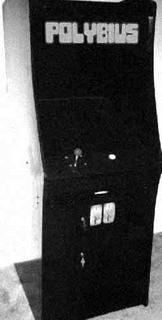
One more and this is a really funny story. It's an urban legend about an old 80's arcade game called "Polybius." Rumor has it that a few of these black, non-descript cabinets were dropped in a few back-alley American arcades. Kids that played them would suffer from nasty syndromes, such as headaches, nausea, nightmares, epilepsy, and suicidal thoughts.
These cabinets disappeared just as quickly as they appeared, presumably because they were some government/paranormal experiment on mind control or some crap like that. Apparently, the Men in Black came to take the cabinets away and only a few vague accounts of the game remain. No roms, no game footage, nothing.
"You know nothing about what just happened here."
This is a fan-made game that's supposedly based on what Polybius was supposed to be like. It's like a really crappy Asteroids clone with seizure-inducing background. I only played it for a minute not because I developed suicidal tendencies, but because it sucked ass. You can download the game in the video description.
So...what does this have to do with Sega? Well, rumor has it (on top of an existing rumor, this is some Inception s*** here) that some of the legacy source code from Polybius was used in the Sega CD BIOS. In other words, because traces of Polybius are in the Sega CD, that means that Sega was involved in the creation of Polybius. Spoooooky. As a matter of fact, a Sega employee posted this cryptic secret on the web and it's very credible and must be believed. This is it in its entirety (when that site self-destructs and all traces are lost) and I don't expect you to read all of it but whatevs...
I was a programmer in Sega's arcade division. Suddenly, we recieved a request to create a game, which was very odd. This would have been ignored, but the source was supposedly a secret organization called "SINNESLOSCHEN", opearting with some sort of governmental power. I am still not sure to this day what country they were working for. We were given a project sheet, and a map of thehuman brain, and how to stimulate those areas, and were told to integrate them into a video game. Sega had quite a bit of money riding on this deal, and were not doing so well. The game took quite a bit of time, and we created technologies that were far beyond our time. A member of the group suggested the name "Polybius", which I remember veing the name of a scholar of some sort. The game's genre could be puzzler, but it also had some odd elements. THIS GAME IS REAL. The game testers who worked for us had odd mind prolems, like losing memory and other such things, like loss of arcadegame fandom. I cannot remember what we designed the arcade case to look like, because it was done by another group. After the project, we signed papers promising secrecy, and if I am discovered, I may get in serious trouble. However, I believe that this needs to be known.
At the beginning of this page, I mentioned the "Sega Genesis CD". I was involved in several projects after "Polybius", and eventually, I ended up on the "Sega Genesis CD" team. While we were designing this, an issue came up. I cannot remember the details, but it involved the two processors synching up. It turns out that Polybius was discovered to use two processors, working in a way similair to what we wanted for the "Sega Genesis CD". We were afraid of getting in trouble for using that game;s code, but we altered the game's BIOS anyway. However, MOST OF THE CODE THAT ACTIVATED THE MIND ALTERING SYSTEM (Details Classified) WERE IN THAT BIOS. The actual game ROM needs the BIOS to run. It was very much like a modern console in that manner. The point is, that I believe we left quite a bit of the "Legacy Code" of "Polybius" in the "Sega Genesis CD", at least in the earliest revisions. However, I was laid off shortly after, and though it was for "Misconduct", I practiced no such thing, and I beleive it was because I accesed Polybius's files. They were likely deleted from Sega's system afterwards.
Really? I don't think that the Sega CD was into mind control cause no one was playing that piece of crap. Although I admit that the console intro (the vacant music) and the Sonic secret message above are pretty creepy.
Rated PG-13 for Language
Good old AVGN...back when he spoke with that snarky tone that is partial inspiration for my angry rants...he also reviews the Sega 32X. It's even less flattering than the Sega CD review.
------------
EDIT:Finally one more, I must add this. Thanks Shenmue Fan for pointing this out. Hajime Satomi, founder of Sammy Entertainment (known for Pachinko machines), bought out Sega in 2004. Satomi is supposedly head of the Yakuza (the Japanese Mafia for you idiots) and Sammy is just his money laundering operation. He hustled down Sega with intimidation, blackmail, etc. (aka "sokaiya") then proceeded to kill Sega like a parasite. If you don't get it by now, let me rehash: SEGA IS OWNED BY THE YAKUZA. Which explains why they've made numerous Yakuza games but not one Shenmue sequel...
You toolbag, they got you making Yakuza games when you should be making Daytona USA 3!!!
Of course, this rumor may have been created to create an alibi for Sega's downfall, but still, you never know.........
------------
Anyway, Sega CD sucks, Sega is creepy, end of story. Oh BTW, Nintendo was once associated with love hotels and the Mafia. And you deliberately had Gunpei Yokoi killed in a car crash after the disaster that was the Virtual Boy. So Nintendo, you're not off the hook either.
Back in the 80's, the original OutRun was a big f'n deal. So big that the game got ports for just about every console you can imagine...even consoles I never even knew existed. For some oddball reason, each version of the game looks & handles differently purely because many of these weren't programmed by Sega themselves. Here's YouTubes of every single version of OutRun right here with my immediate rating out of 5. Please note if you're sentimental towards one version that I rated poorly, well tough break...
Amiga (2/5, mega crap right out the gate)
Amstrad CPC (2/5, the music makes me laugh)
Arcade (5/5, duh)
Commodore 64 (2/5, the VW Beetle dodging simulator!! EDIT: Wait, no branching paths...-minus-1 point there)
Sega Genesis (4/5, still looks weird compared to arcade version but still very good)
Sega GameGear (3/5, lol, mini OutRun, oh yea!! but only 10 stages tho)
iPhone (actually named Final Freeway, it's an obvious ripoff) (3/5, looks unique, tilt the phone to steer but it's not really OutRun so minus 1 point)
MSX (1/5, holy cow)
PC (NOT emulator) (4/5, not bad)
Playstation 2 (part of Sega Classics Collection) (4/5, the car looks weird but at least it's smooth driving)
Sega Master System (3/5, too quirky for me)
Sega Saturn (part of Sega Ages) (5/5, basically identical to arcade version)
Atari ST (3/5, basically the Amiga version but with snazzier music and a smaller screen)
TurboGrafx-16 (4/5, delightfully surprised by this one) NOTE: Old video got deleted, this is the only one left. Not like people are rushing to upload OutRun on the TurboGrafx so gimme a break. I recall it being very similar to the PC version so nothing truly groundbreaking.
Sinclair ZX Spectrum (-1,000,000/5, ANOTHER mangled version of Splash Wave, worst port ever)
I think that's every version--if there's one or two I missed, let me know so I can add 'em. And we haven't even touched on Turbo OutRun, OutRun Europa, OutRun 2019, OutRunners...geez. Basically, OutRun games up the ass. If only we could've pooled all the energy put into these ports into OutRun 3, that would be great. I also complain about how overrated today's graphics are, but with those old graphics, no amount of gameplay can save it...
Oh, and don't think Daytona USA got off the hook. I may get to that sometime...I'm saving that for later.
10. Victory Run (Turbografx-16)
9. Ivan "Ironman" Stewart's Super Off-Road (Sega Genesis)
8. Marauder - Rock & Roll Racing (Sega Genesis)
7. Battle Cars (SNES)
6. Jaguar XJ220 (Sega Genesis)
5. Zero 4 Champ RR (Super Famicom)
4. Super Mario Kart (SNES) 3. Virtua Racing (Sega Genesis NOT 32X)
2. F-Zero (SNES) 1. OutRun (Sega Genesis)
Might I remind you that I contributed nothing to the votes. Lessseeee here...you got Nintendo juggernauts Mario Kart & F-Zero. And then here comes Outrun and Virtua Racing (the GENESIS version, remind you) which top 'em. Well done, voters!!! Cartoon go-karts and space racers may be interesting in a fantasy setting, but in the end, it's all about the work of modern artisans and technicians that hits the pavement...
Holy crap, look at the people at :36...it's Gumby!!
Not the flashiest version of OutRun...
These are on the measly Genesis so give them a break. And there you have it, Sega racers score more points out there.